
Inside a Traditional Herring Smokehouse in Boulogne-sur-Mer
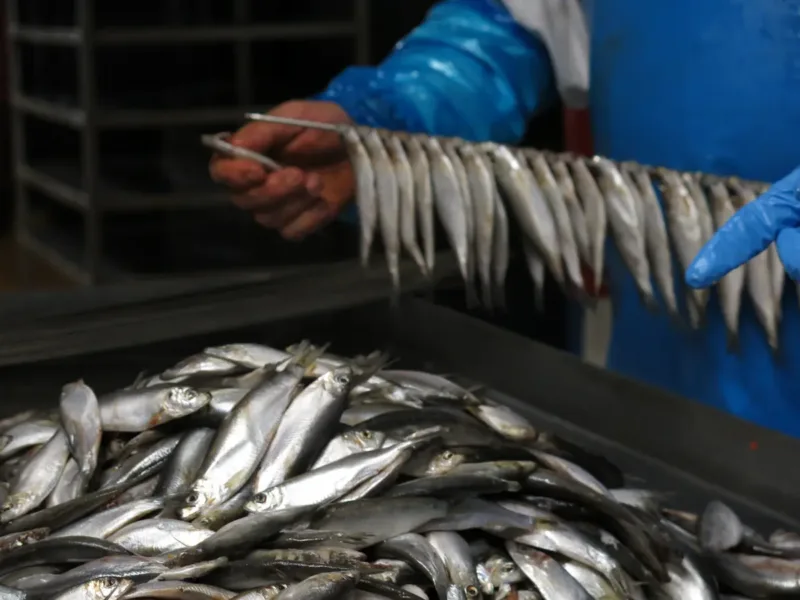
Boulogne-sur-Mer is France’s leading fishing port — and one of the last places in Europe where herring is still smoked and salted by hand, using traditional wood-fire techniques passed down through generations. Corrue-Deseille, a fourth-generation family business in the Capécure district, is one of only four traditional smokehouses still operating in the city. This is what happens inside.
Corrue-Deseille: one of the last traditional smokehouses in France
This is the story of a family steeped in ancient values and traditions. Corrue-Deseille is one of the very last traditional fish smoking and salting companies in Boulogne-sur-Mer.
8.00am: Cédric Corrue meets us for our visit to the Corrue-Deseille smoking and salting factory, which he manages alongside his brother Pierre. The premises are located in the Capécure area of Boulogne-sur-Mer, dedicated to fishing and fish processing. As the busiest fishing port in France, the family-owned company is supplied with fresh fish every day.
Although this seems like an extremely early start for a visit, once inside the factory we soon realise that the workers have already been hard at it for several hours. Fish is, above all else, a family matter here: Pierre and Cédric are the fourth generation to manage the company. There are only four traditional smoking and salting factories remaining today, although there were more than 80 at the start of the 20th century.
According to Cédric, the company’s strength lies in just one or two key factors: an insistence on top-quality ingredients, the upkeep of an ancient tradition and the passion of the staff.
Visit Corrue-Deseille in Boulogne-sur-Mer
-
Address: 24 Rue du Docteur Duchenne, Boulogne-sur-Mer
-
Phone :+33 (0)3 21 33 17 33
-
Website: corrue.fr
Email: contact@corrue.fr
-
What is smoked at Corrue-Deseille?
Every year, one thousand tons of finished products are processed at Corrue-Deseille, including 450 tons of herring products, their speciality. Herring is also the origin of the business. All their products were based on herring in the time of Cédric’s parents: kippers, cured herring, marinated herring, sweet herring fillets, rollmops. Other varieties of fish arrived later, to meet the growing demand of consumers.
 © A. Chaput Pas-de-Calais Tourisme
-
How traditional smoked herring is made: step by step
Step 1 — Salting and preparation
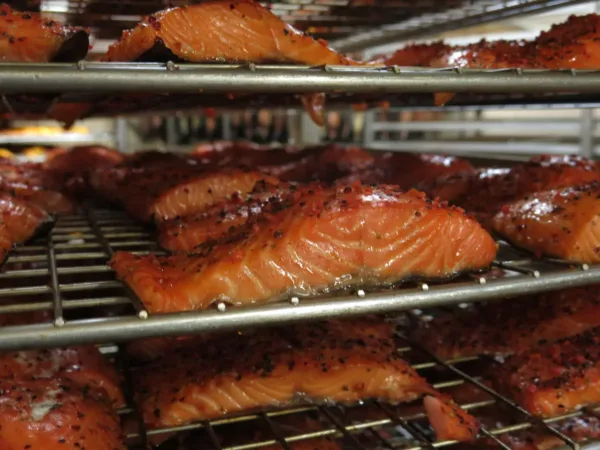
8:30am: our visit begins in the storeroom where the herring, haddock and salmon are kept. Herring purchased between November and December comes, in part, from local fishermen. One of the very first stages of preparation is salting: the fish is placed whole in brine for between 48 and 72 hours. Certain fish are gutted, others not. The salmon and haddock are then placed on wire racks whilst the herring is hung. Each fish follows its own process. Salting, gutting and setting out are only done by hand in order to ensure that as little of the flesh is lost as possible.
Step 2 — Wood-fire smoking
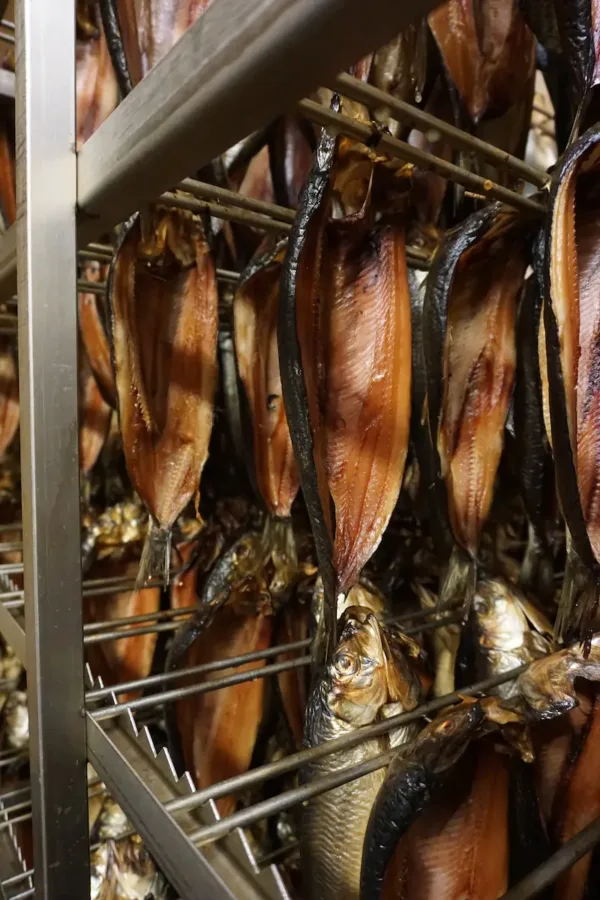
9am: after watching the preparation, we head into the smoking room — the heart of the company. Up above, a statue of the Virgin Mary keeps watch. The people of Boulogne are superstitious and the Virgin protects them from fires. Hot or cold, smoking is done in the traditional way and can last until 6pm.
Just beneath the smoking room sits the cellar, where the smoker prepares the fire using logs, wood shavings and sawdust from beech trees. This is a delicate phase: the amount used must be precise, the objective being to produce nothing but smoke.
Step 3 — Filleting, cutting and conditioning
9:30am: we witness the very last stages of the process prior to shipping — filleting, cutting and conditioning in wooden crates. Here again, all tasks are carried out by hand in order to protect the flesh of each fish. The precision and speed of the cutters is impressive: salmon, trout and halibut are all in expert hands.
Cédric suggests we try a few slices of freshly cut smoked trout. Despite the early hour, we are happy to accept. The fish is an absolute delight and really does melt in the mouth.
The finished products are delivered to restaurants, wholesalers and retailers in France and across Europe.
 © M. Harmel Pas-de-Calais Tourisme



Frequently asked questions about smoked fish in Boulogne-sur-Mer
-
What is a traditional fish smokehouse in Boulogne-sur-Mer?
A traditional smokehouse in Boulogne-sur-Mer is a facility where fish — primarily herring, haddock and salmon — is salted and smoked by hand using wood fires, following techniques that date back over a century. Only four such traditional smokehouses remain in Boulogne today, compared to more than 80 at the start of the 20th century.
-
What fish is smoked in Boulogne-sur-Mer?
The main fish smoked in Boulogne-sur-Mer are herring, haddock and salmon. Herring remains the historic speciality, produced as kippers, cured herring, rollmops and marinated fillets. Trout, halibut and other species are also processed to meet modern demand.
-
Can you visit a smokehouse in Boulogne-sur-Mer?
Yes. Corrue-Deseille, located in the Capécure district of Boulogne-sur-Mer, welcomes visitors. The factory produces around 1,000 tonnes of smoked and salted fish products per year and offers an insight into the traditional techniques still used today.
-
Why is Boulogne-sur-Mer famous for smoked herring?
Boulogne-sur-Mer is France’s leading fishing port and has been a centre of herring smoking and salting for over a century. Its Capécure district remains Europe’s largest seafood processing zone, with nearly 200 companies. The tradition of wood-fire smoking is still maintained by a handful of artisan producers.
-
What is a kipper?
A kipper is a whole herring that has been split, cold-smoked and cured. It is a traditional product closely associated with both British and northern French food culture. In Boulogne-sur-Mer, kippers are still produced by hand at traditional smokehouses such as Corrue-Deseille, using beech wood smoke.