The Ring of Remembrance at Notre-Dame-de-Lorette : 580,000 names, one message
The Ring of Remembrance in Pas-de-Calais engraves 579,606 names from the First World War, soldiers of 40 nationalities, listed alphabetically with no distinction of rank or flag. It is free to visit, open year-round, and stands 45 minutes from Calais. What most British visitors do not know is that 241,214 of those names belong to the British imperial army, the largest single national grouping on the memorial. This article covers the architecture, the names, and how to spend a full day on the Artois ridge.
An ellipse on a hillside, and 580,000 names with no rank, no nation
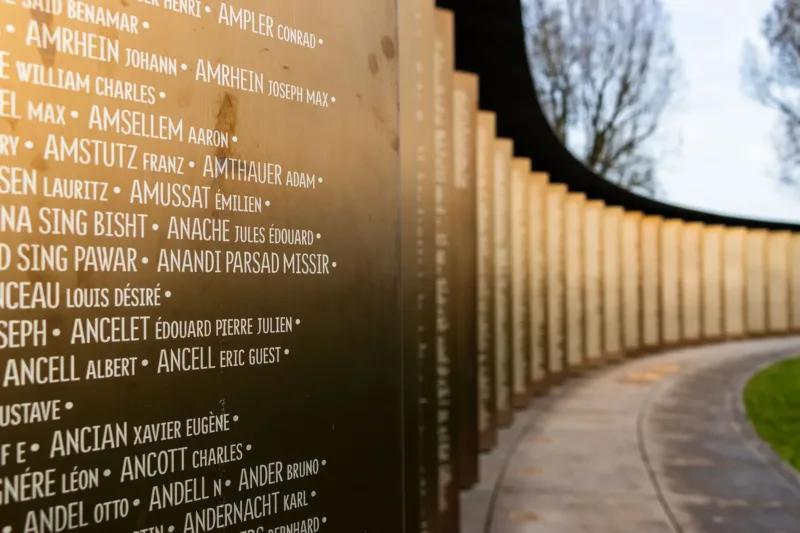
The first name engraved on the Ring of Remembrance belongs to a Nepalese sailor. The last, Zschiesche, Paul, is German. Between them, in strict alphabetical order, lie 579,606 names. No ranks. No nationalities. No flags.
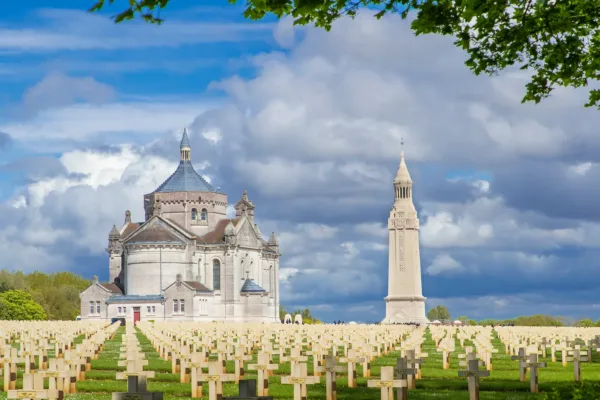
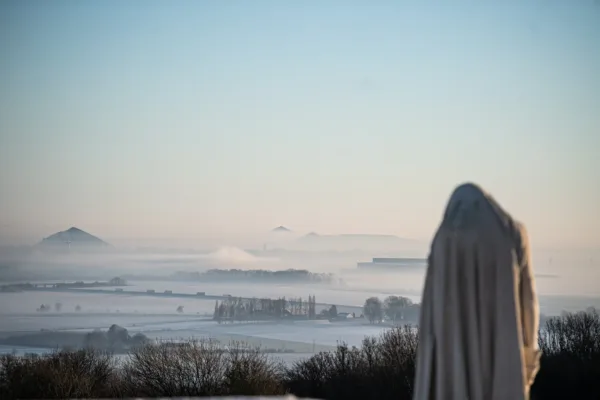
The Anneau de la Mémoire stands on the slope of the plateau at Ablain-Saint-Nazaire, Pas-de-Calais, facing the main entrance to the Notre-Dame-de-Lorette National Necropolis. Its address: D58E3, Chemin du mont de Lorette, 62153 Ablain-Saint-Nazaire. It was built to honour every soldier who died on Nord-Pas-de-Calais soil between 1914 and 1918. It is the first memorial in history to list all their names alphabetically, with no distinction of nationality, rank, gender, or religion.
Practical information :
-
Adress : D58E3, Chemin du mont de Lorette, 62153 Ablain-Saint-Nazaire
-
Phone : +33 (0)3 21 74 83 15.
-
Hours of operation : Open all day. Lighting runs until 23:00
-
Philippe Prost and the design
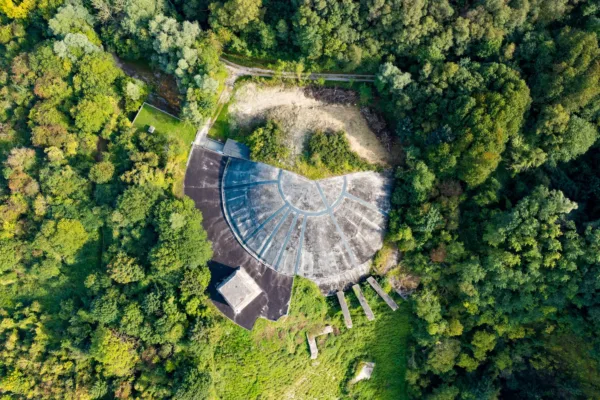
The memorial was designed by French architect Philippe Prost, selected through a public contest. The decision was taken on 13 April 2011. The structure consists of 500 stainless steel panels, each 3 metres high. The 499 engraved panels each carry approximately 1,200 names. The 500th panel is left deliberately blank, for names still to be discovered, an ongoing act of historical recovery that has no scheduled end date.
The ellipse measures 345 metres in circumference. 56 metres of the structure hang over the hillside, an overhang that was not an engineering accident: it was designed to embody the fragility of peace. The copper-plated panels develop a patina over time, the material itself ageing alongside the history it records.
 © Yannick Cadart-CD 62
-
A typeface designed for the dead
Every name is set in a typeface created specifically for this memorial. French graphic designer and typographer Pierre di Sciullo designed it. He named it Lorette. No other memorial uses it.
The inauguration took place on 11 November 2014, the 96th anniversary of Armistice Day, by French President François Hollande. Among those present was Ursula von der Leyen, then German Minister of Defence. The fact that Germany’s defence minister stood at a French WW1 memorial on Armistice Day is not a footnote.
“No ranks, no nationalities: just a dizzying list of the human stories that ended on France’s northern battlefields.”
 © M. Torond Pas de Calais Tourisme
-
The ring of remembrance in numbers
Architectural element Specification Circumference of ellipse 345 m Overhang above hillside 56 m Number of panels 500 (499 engraved + 1 blank) Panel height 3 m Names per panel (avg.) ~1,200 Total names engraved 579,606 Typeface Lorette, by Pierre di Sciullo Inauguration date 11 November 2014 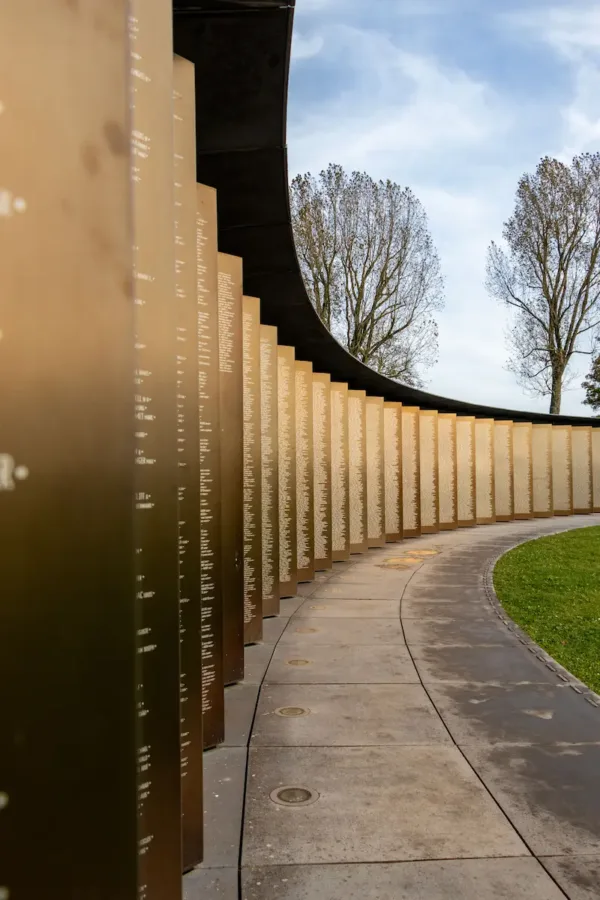 © S. Brissaud Pas de Calais Tourisme
-
241,214 British imperial names — and why this matters for UK families
Of the 579,606 names on the Ring (some institutional sources round this to 580,000; the variance is minor and reflects ongoing archival updates), the largest single national grouping does not belong to France. It belongs to Britain.
241,214 names on the Anneau de la Mémoire are those of soldiers, workers and nurses of the British imperial army, killed in the Nord-Pas-de-Calais sector between 1914 and 1918. That figure alone makes the Ring the most significant WW1 memorial of its kind for British visitors.
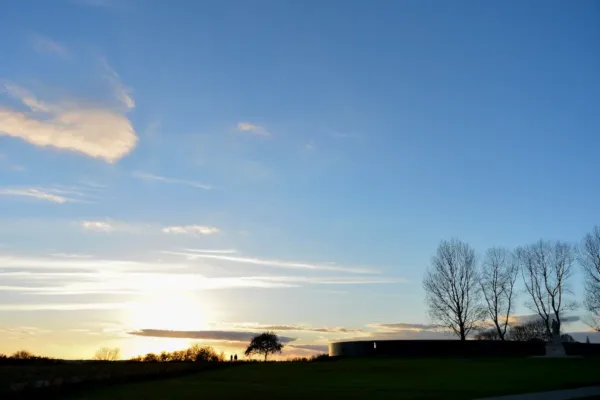 © Yannick Cadart-CD 62
-
The Ring as a genealogy resource
For British, Australian, Canadian, South African and Indian families researching relatives lost on the Artois front, the Ring is a direct and searchable resource. The CWGC (Commonwealth War Graves Commission) database lists Commonwealth soldiers separately and authoritatively, and remains the best starting point for confirmed grave locations. But the Ring does something different: it places 241,214 British imperial names in a single alphabetical sequence alongside their adversaries and allies of 40 nationalities, with no hierarchy between them. This is the first memorial of this type erected since the end of the war.
The blank 500th panel is relevant here too. Approximately 40% of Great War soldiers have no known grave. For those men, with no headstone and no CWGC record, the Ring gives a place of named remembrance where none otherwise exists. The panel reserved for newly discovered names has no closing date.
“In these substantial lists of names, perhaps you will find your own surname, belonging to your predecessors or distant cousins.”
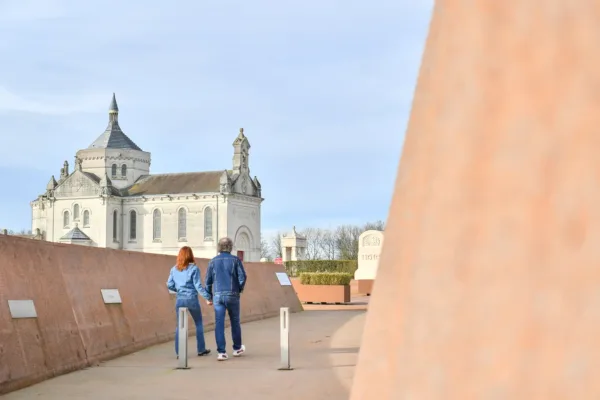
Getting there : distances from the Channel
| Departure point | Distance | Approx. driving time |
| Calais | 55 km | 45 min (A26 / A21) |
| Arras | 15 km | 20 min |
| Lens | 12 km | 15 min |
| Vimy Ridge | 6 km | 10 min |
| Boulogne-sur-Mer | 70 km | 55 min |